Please log in to read this in our online viewer!
Please log in to read this in our online viewer!
 2012 · 6 page(s) (477 KB)
 English
 24
24
 March 04 · 2019
 Logging in required

 Embed
Embed
No comments yet. You can be the first!
What did others read after this?

Content extract
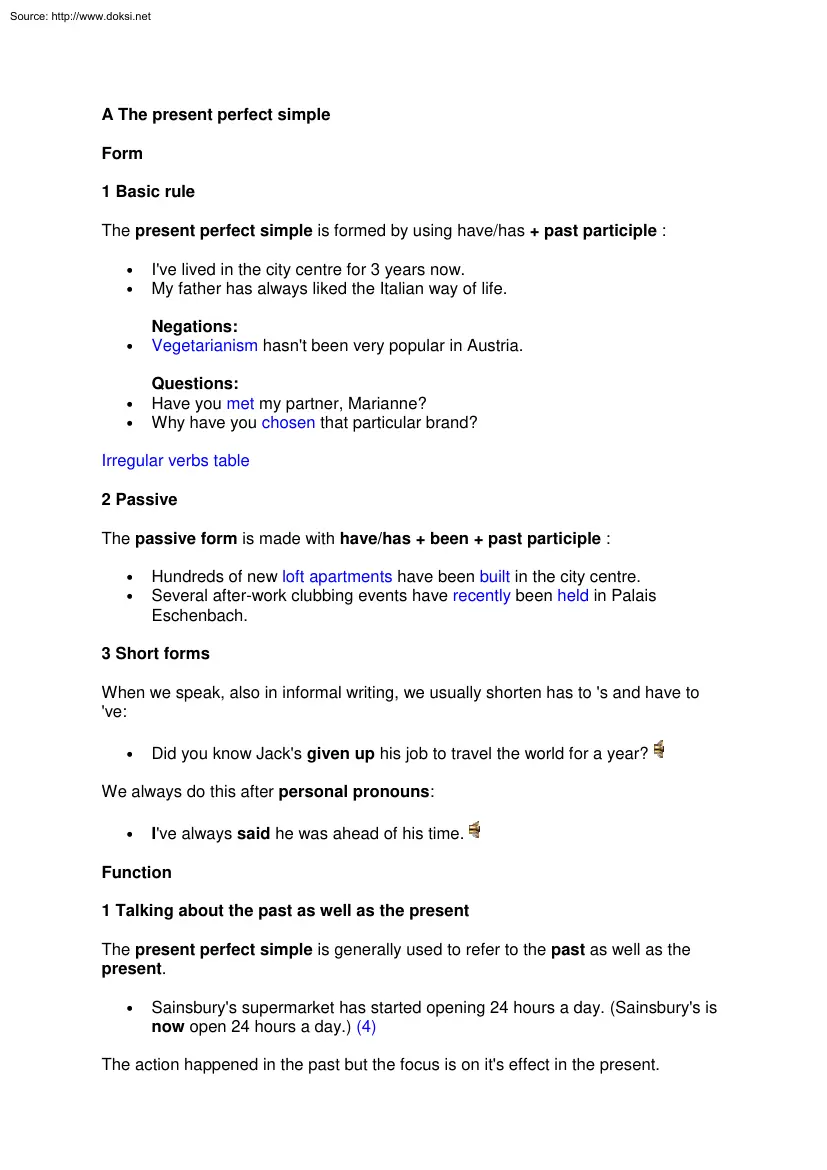
Source: http://www.doksinet A The present perfect simple Form 1 Basic rule The present perfect simple is formed by using have/has + past participle : • • I've lived in the city centre for 3 years now. My father has always liked the Italian way of life. • Negations: Vegetarianism hasn't been very popular in Austria. • • Questions: Have you met my partner, Marianne? Why have you chosen that particular brand? Irregular verbs table 2 Passive The passive form is made with have/has + been + past participle : • • Hundreds of new loft apartments have been built in the city centre. Several after-work clubbing events have recently been held in Palais Eschenbach. 3 Short forms When we speak, also in informal writing, we usually shorten has to 's and have to 've: • Did you know Jack's given up his job to travel the world for a year? We always do this after personal pronouns: • I've always said he was ahead of his time. Function 1
Talking about the past as well as the present The present perfect simple is generally used to refer to the past as well as the present. • Sainsbury's supermarket has started opening 24 hours a day. (Sainsbury's is now open 24 hours a day.) (4) The action happened in the past but the focus is on it's effect in the present. Source: http://www.doksinet Compare this with the past simple , which tells us about past actions with a focus on the time in the past when they happened. We are not talking about any effects on the present here: • Sainsbury's supermarket started opening 24 hours a day last week. (We don't know and it doesn't matter if it is still open 24 hours now.) Past simple: function Here are two more examples of the present perfect showing a connection to the present: • • Sue and I have known each other for 12 years. (We are still friends now) (2) Have you ever seen the film "La Dolce Vita"? (Do you know it now?) (5) 2
Continued actions that started in the past We use the present perfect simple to talk about actions and situations which began in the past and have continued up to the moment of speaking, or just before: • • I've lived in Austria since 1983 (and I'm still here). We've known each other for a long time (and we still know each other). We also use the present perfect simple to talk about repeated actions within the time up to the present: • I've often wondered where she gets the money for her lifestyle. (We don't know when the speaker started wondering but we do know that they still don't know the answer.) Present perfect continuous for continued actions 3 Expressions of time The present perfect simple is often used with time expressions which refer to a time period which leads up to the present, such as since and for: • • They've worked here for three months. (a period of time) They've worked here since June. (a specific point in time
marking the beginning of the period) Other time expressions often used with the present perfect simple: recently, lately, so far, still, yet, today, this morning/evening, etc. • • • • I haven't had a holiday this year. We haven't had any problems so far. I haven't had any decent sushi recently. "Have you seen Jack today?" - "No. He hasn't been around a lot lately" Source: http://www.doksinet • "Have you finished that book yet?" - "No, I still haven't had time to look at it." 4 Present effects The present perfect simple is often used to talk about past actions which have finished but have some importance for the speaker in the present time. It is not important when it happened, it is more important for the speaker that it has happened. (This use is not as common in the US, where the past simple is often used instead.) • • • The boss has been fired. (The boss is no longer here now) Reebok has agreed
to sponsor this year's marathon. (Reebok is the sponsor) I can't go on holiday because I haven't done the accounts yet. (There is still work to do.) For the same reason, we often use the present perfect simple to show how much or how many: • I've jogged 5 miles so far. (I'm 5 miles farther now than when I started) But if a definite time is mentioned the past simple should be used: • • Sepp first went to India in 1988. Five years ago I decided to give up meat and become a vegetarian. Past simple: Definite time in the past Also compare this with the present perfect continuous for emphasising the action itself rather than the fact that it has happened. • • I'm completely exhausted - I've been doing the accounts all day. (This has kept me busy all the time.) Sepp's been travelling to India since 1988. (He's done it again and again) Present perfect continuous: focus on the action 5 Life experience We use the present perfect
simple to talk about past actions which have finished but belong to our life experience, which is seen as a period that continues up to the present time: • We've done a quite a bit of travelling in South-East Asia. (I'm not thinking of a particular trip in a particular year but of all the travelling we've done over the years.) Certain time expressions are often used with the present perfect simple when it refers to our life experience: ever, never, always, already, yet. • Have you ever seen the film "La Dolce Vita"? Source: http://www.doksinet • • She's never driven a sports car through Paris. Ms McCartney hasn't reached her first million yet, but she will. When we talk about our life experience, we focus on the fact that something has happened. Compare this with the present perfect continuous for emphasising the action itself rather than the fact that it has happened. • Ms McCartney's business has been making money for years
now. Present perfect continuous: focus on the action B The present perfect continuous Form 1 Basic rule The present perfect continuous is formed with has/have + been + the -ing form of the verb: • • Since his pay rise, Paul's been spending money without thinking. The children have been asking for the latest Playstation software all week. • Negations: They haven't really been watching the film, they've been quarrelling all the time. • • Questions: Have you been following the latest news about the strikes? What has she been saying about me? 2 Short forms When we speak, also in informal writing, we usually shortenhas to 's and have to 've: • Did you know Karl's been thinking of emigrating to New Zealand? We always do this after personal pronouns: • I've been watching that new TV programme, "Single in the City". 3 Passive We cannot use the present perfect continuous in the passive. Function 1 Continued actions Source:
http://www.doksinet We mainly use the present perfect continuous to talk about an action that began in the past and continues over a period of time up to the time of speaking, or just before: • This Spanish-owned chain has been expanding rapidly throughout Europe. (They are probably still expanding.) • You look exhausted - what have you been doing? (You're either still doing it or you've only just stopped, I can tell from the way you look.) We often use the present perfect contintuous to talk about how long something has been happening, especially with for, since, and how long. • • How long have you been waiting? (The other person is still waiting or has only just stopped.) We've been subscribing to "Vogue" for six years now. (We are still subscribing to the magazine.) No present perfect continuous with state verbs 2 Focus on the action We particularly use the present perfect continuous to talk about actions happening over a period up to the
present when we want to focus on the action itself: • • We've been working on a new design. There hasn't been time for anything else. (We've been so busy all the time) Someone's been eating my biscuits. (This action must have been going on for a while, there are just a few left.) We often use the present perfect continuous together with time expressions that say how long something has been going on: • • I've been jogging for 30 minutes now. I've been eating biscuits since I sat down at my desk. Expressions of time We also use the present perfect continuous to talk about repeated actions happening over a period up until the present: • Sepp's been going to India since 1988. (He's done it again and again) Note: We use the present perfect simple when we are more interested in the fact that it has happened: • • We've worked out a new design. I think you'll like it much better than the old one. (We've got a new
design now) Someone's eaten my biscuits. (They're all gone now) Source: http://www.doksinet • Sepp's gone to India. (He's there now) Present perfect simple: present effects We also use the present perfect simple if we refer to how many or how much: • • • I've jogged 5 miles so far. (WRONG: I've been jogging 5 miles so far.) Someone's eaten half of my biscuits. (WRONG: Someone's been eating half of my biscuits.) No present perfect continuous with state verbs 3 State verbs Some verbs which express states are not used in the continuous, e.g believe, consist of, contain, depend, exist, hate, know, like, mean, need, own, prefer, seem, understand, want, wish. • I've known he was a liar ever since I first met him. (WRONG: I've been knowing he's a liar.) Some verbs have two different meanings, an action meaning and a state meaning. The state meaning usually cannot be made continuous: • • We've been admiring the
view from your window. (Action: We've been looking at it with pleasure.) I've always admired his courage. (State: I've always approved of it.) (WRONG: I've always been admiring his courage.) See these verbs in the present continuous See these verbs in the past continuous Verwandte Ressourcen Entwicklung & Design der Learn@WU-Plattform: Abteilung für Wirtschaftsinformatik, Wirtschaftsuniversität Wien Nutzungsbedingungen
Talking about the past as well as the present The present perfect simple is generally used to refer to the past as well as the present. • Sainsbury's supermarket has started opening 24 hours a day. (Sainsbury's is now open 24 hours a day.) (4) The action happened in the past but the focus is on it's effect in the present. Source: http://www.doksinet Compare this with the past simple , which tells us about past actions with a focus on the time in the past when they happened. We are not talking about any effects on the present here: • Sainsbury's supermarket started opening 24 hours a day last week. (We don't know and it doesn't matter if it is still open 24 hours now.) Past simple: function Here are two more examples of the present perfect showing a connection to the present: • • Sue and I have known each other for 12 years. (We are still friends now) (2) Have you ever seen the film "La Dolce Vita"? (Do you know it now?) (5) 2
Continued actions that started in the past We use the present perfect simple to talk about actions and situations which began in the past and have continued up to the moment of speaking, or just before: • • I've lived in Austria since 1983 (and I'm still here). We've known each other for a long time (and we still know each other). We also use the present perfect simple to talk about repeated actions within the time up to the present: • I've often wondered where she gets the money for her lifestyle. (We don't know when the speaker started wondering but we do know that they still don't know the answer.) Present perfect continuous for continued actions 3 Expressions of time The present perfect simple is often used with time expressions which refer to a time period which leads up to the present, such as since and for: • • They've worked here for three months. (a period of time) They've worked here since June. (a specific point in time
marking the beginning of the period) Other time expressions often used with the present perfect simple: recently, lately, so far, still, yet, today, this morning/evening, etc. • • • • I haven't had a holiday this year. We haven't had any problems so far. I haven't had any decent sushi recently. "Have you seen Jack today?" - "No. He hasn't been around a lot lately" Source: http://www.doksinet • "Have you finished that book yet?" - "No, I still haven't had time to look at it." 4 Present effects The present perfect simple is often used to talk about past actions which have finished but have some importance for the speaker in the present time. It is not important when it happened, it is more important for the speaker that it has happened. (This use is not as common in the US, where the past simple is often used instead.) • • • The boss has been fired. (The boss is no longer here now) Reebok has agreed
to sponsor this year's marathon. (Reebok is the sponsor) I can't go on holiday because I haven't done the accounts yet. (There is still work to do.) For the same reason, we often use the present perfect simple to show how much or how many: • I've jogged 5 miles so far. (I'm 5 miles farther now than when I started) But if a definite time is mentioned the past simple should be used: • • Sepp first went to India in 1988. Five years ago I decided to give up meat and become a vegetarian. Past simple: Definite time in the past Also compare this with the present perfect continuous for emphasising the action itself rather than the fact that it has happened. • • I'm completely exhausted - I've been doing the accounts all day. (This has kept me busy all the time.) Sepp's been travelling to India since 1988. (He's done it again and again) Present perfect continuous: focus on the action 5 Life experience We use the present perfect
simple to talk about past actions which have finished but belong to our life experience, which is seen as a period that continues up to the present time: • We've done a quite a bit of travelling in South-East Asia. (I'm not thinking of a particular trip in a particular year but of all the travelling we've done over the years.) Certain time expressions are often used with the present perfect simple when it refers to our life experience: ever, never, always, already, yet. • Have you ever seen the film "La Dolce Vita"? Source: http://www.doksinet • • She's never driven a sports car through Paris. Ms McCartney hasn't reached her first million yet, but she will. When we talk about our life experience, we focus on the fact that something has happened. Compare this with the present perfect continuous for emphasising the action itself rather than the fact that it has happened. • Ms McCartney's business has been making money for years
now. Present perfect continuous: focus on the action B The present perfect continuous Form 1 Basic rule The present perfect continuous is formed with has/have + been + the -ing form of the verb: • • Since his pay rise, Paul's been spending money without thinking. The children have been asking for the latest Playstation software all week. • Negations: They haven't really been watching the film, they've been quarrelling all the time. • • Questions: Have you been following the latest news about the strikes? What has she been saying about me? 2 Short forms When we speak, also in informal writing, we usually shortenhas to 's and have to 've: • Did you know Karl's been thinking of emigrating to New Zealand? We always do this after personal pronouns: • I've been watching that new TV programme, "Single in the City". 3 Passive We cannot use the present perfect continuous in the passive. Function 1 Continued actions Source:
http://www.doksinet We mainly use the present perfect continuous to talk about an action that began in the past and continues over a period of time up to the time of speaking, or just before: • This Spanish-owned chain has been expanding rapidly throughout Europe. (They are probably still expanding.) • You look exhausted - what have you been doing? (You're either still doing it or you've only just stopped, I can tell from the way you look.) We often use the present perfect contintuous to talk about how long something has been happening, especially with for, since, and how long. • • How long have you been waiting? (The other person is still waiting or has only just stopped.) We've been subscribing to "Vogue" for six years now. (We are still subscribing to the magazine.) No present perfect continuous with state verbs 2 Focus on the action We particularly use the present perfect continuous to talk about actions happening over a period up to the
present when we want to focus on the action itself: • • We've been working on a new design. There hasn't been time for anything else. (We've been so busy all the time) Someone's been eating my biscuits. (This action must have been going on for a while, there are just a few left.) We often use the present perfect continuous together with time expressions that say how long something has been going on: • • I've been jogging for 30 minutes now. I've been eating biscuits since I sat down at my desk. Expressions of time We also use the present perfect continuous to talk about repeated actions happening over a period up until the present: • Sepp's been going to India since 1988. (He's done it again and again) Note: We use the present perfect simple when we are more interested in the fact that it has happened: • • We've worked out a new design. I think you'll like it much better than the old one. (We've got a new
design now) Someone's eaten my biscuits. (They're all gone now) Source: http://www.doksinet • Sepp's gone to India. (He's there now) Present perfect simple: present effects We also use the present perfect simple if we refer to how many or how much: • • • I've jogged 5 miles so far. (WRONG: I've been jogging 5 miles so far.) Someone's eaten half of my biscuits. (WRONG: Someone's been eating half of my biscuits.) No present perfect continuous with state verbs 3 State verbs Some verbs which express states are not used in the continuous, e.g believe, consist of, contain, depend, exist, hate, know, like, mean, need, own, prefer, seem, understand, want, wish. • I've known he was a liar ever since I first met him. (WRONG: I've been knowing he's a liar.) Some verbs have two different meanings, an action meaning and a state meaning. The state meaning usually cannot be made continuous: • • We've been admiring the
view from your window. (Action: We've been looking at it with pleasure.) I've always admired his courage. (State: I've always approved of it.) (WRONG: I've always been admiring his courage.) See these verbs in the present continuous See these verbs in the past continuous Verwandte Ressourcen Entwicklung & Design der Learn@WU-Plattform: Abteilung für Wirtschaftsinformatik, Wirtschaftsuniversität Wien Nutzungsbedingungen